Tuesday, October 23, 2012

Nigeria's ANC Challenge: The Midfield Options

As I stated here,  the key tactical challenge for Nigeria in midfield at the Africa Nations Cup (ANC) will revolve around the decision on who to sorround Mikel with in midfield .
 
There is little question that John Mikel Obi is Nigeria's best central midfielder.. While I have often criticized the direction of his development and personal ambition as a player, there is little doubt that even in the narrow, regimented role he has at Chelsea, when he is on top of his game, he plays at a very high level.

For the purpose of this article, the assumption of course is that Mikel's role in the Super Eagles mirrors his role at Chelsea and is accepted as fait accompli.
  
The challenge then is to achieve complementarity within this framework, first in the choice of players around him, and second in the identification and designation of roles between the holding player, the ball winner and the attacking/creative player, with the primary goal being to achieve tactical balance in midfield.
 
From the body of work of Steven Keshi so far, especially the two games against Liberia, it is clear that whatever formation he chooses, Nigeria must deploy a minimum of three central midfielders (or covering players) to be successful.
 
With Mikel Obi in a holding role, a ball winning midfielder, with box-to-box capability is needed. The players in competition for this spot include, Fengor Ogude, Reuben Gabriel, and Obiora Nwnakwo.
 
Of the three players, Fengor Ogude is recovering from injury and slated to return later this month. But with the Norwegian Tippeligaen now past Week 26, there are only four more weeks left for him to be involved in competitive league football. This is probably not enough for a player returning from a long term injury, and who in a tournament will be expected to play multiple games within a week.
 
On the other hand Reuben Gabriel is reported to be sidelined for three months with a groin complaint Source. With the Nigerian season over, its clear Reuben, like Ogude, will not be available for the Nations Cup, which leaves the team with Obiora Nwankwo.
 
Since leaving Inter Milan in 2010 to Parma, initially on loan, Obiora Nwankwo's career has nosedived steadily and precipitously. In nearly one year at Parma (2010/2011-2011/2012) he would play a total of two games for 64mins, and was subsequently loaned to Gubbio, where he appeared to pick up his career, making 18 appearances last season. Having returned to Parma at the end of the season, he was again loaned to Padova his current club, where he has played just three games, all as subs, for a total of 63mins, including a five minute cameo against Reginna, a match in which Daniel Adejo got a late winner...
 
The reason I have gone in detail about Nwankwo's career is to show proof of the potential risk for the Super Eagles in being dependent on a player who is not only playing at a lower level, but is simultaneously lacking in regular games.

Let there be no misunderstanding. Obiora Nwankwo is talented. However his development as a player has stalled. Ditto for Raheem Lawal who now plays in the Turkish second division.

Technically, Nwankwo lacks the speed and verticality to be effective in a high pressing game or the tactical awareness to read opposing movements. In any case, such tactical awareness is Mikel's stronger point. 

If he is retained in the current Super Eagles, the best use that can be made of him is perhaps in a deep role in front of the back four. A rigorous ANC camp will be of great value to this player.

On the basis of these identified weaknesses the recent decision by the team's handlers to look seriously at additional options like Ramon Azeez is wellcome.

The problem though is that Azeez has not been regular for Almeria II, the B-team of an Almeria team that plays in the second division of the spanish league, and sustained a knock in a recent Copa del Rey game against Alcorcon. That is poor level for a Nigerian international player.

Izunna Uzochukwu on the other hand has been very impressive this season for the Danish Superliga side FC Midtjylland, continuing from where he left off as the team's best player last season. A combative player who sometimes plays too close to the edge, he has the skills to play as a ball winner or a holding midfielder.

A wild card option might be the Arsenal starlet, Chuks Aneke who is currently on loan with Crewe in the English championship. A very talented player whose main advantage is that he is the beneficiary of a world class development curriculum, both at Arsenal and at Crewe. He not only understands the position, but is a very confident player, and although only 19 years old is physically well equipped for the rough and tumble of African football. 

In left central midfield, there is, I think, a real place for Joel Obi whose control, technical skills and workrate, bring great balance on the left of Mikel; more than any other midfield player available to the Super Eagles at the moment. At the end of the Siasia era, his understanding with Mikel Obi had grown exponentially and needs to be harnessed further in developing the current team. Next to Mikel, he is overall, easily the next best Nigerian central midfielder at the moment. His workrate and mobility means he can be effective in a pressing game, while his ball skills means he can run at a defence when necessary, even from wide positions, as well as break into the box on late runs.
 
In the attacking midfield role, Nosa Igiebor has recently emerged as a key player. Nosa is a talented player with decent ball skills but lacking in tactical awareness and a broad vision of the field, especially in how to position himself among his teammates, and the ability to play between the lines.

The other option for Nigeria is to play Victor Moses in this role, an area he has prior experience in, from his days at Wigan under Roberto Martinez. His experience as a wide player can in addition help the team overload the flanks in the attacking phase. He has the explosiveness to be decisive in this area, as long as he avoids some of the showboating he displayed against Liberia.

The third option is of course Sidney Sam, but there are as yet no clear and conclusive signs that he has signed on to the Nigeria project. However should he become available, he has the technique and the overall ability to elevate the Nigerian attacking game in midfield, and like Moses, the ability to transform into the so-called 'central winger', playing both centrally and wide to help overload the flanks.
 

Monday, October 15, 2012

Moving Forward to South Africa

Congratulations to all the teams that have qualified for the Nations Cup in South Africa.
 
We now look forward to the draws coming up in Durban in just over a week.
 
The biggest upset is obviously the victory of Cape Verde over Cameroon. However, reality is Cameroon has been poor for a long time and is beset with internal wranglings, administrative ineptitude, and corruption at multiple levels. And worse, there are no signs it will get better...
 
Conversely, its great to see the return of former African powerhouse Congo DR, led by the old coaching war horse, Claude Leroy, who was nearly driven to fits on the sidelines in Malabo as his team paraded a defence with enough gaps to fit three mack trucks, with a little additional room for a mini! With some adjustments at halftime coupled with greater control in midfield, they easily saw off a poor Equatorial Guinea team. But much work needs to be done on the defensive side of the game... 
 
But the real drama I thought was in Marrakech where Morocco stormed to a 4-0 win to overturn a two-goal first leg deficit. Having sacked the dissapointing Eric Gerets and dropped a few regulars, Rachid Taoussi has to be the coach of the week in leading the team to qualify, in a game Liverpool's Oussama Assaidi was at times simply brilliant. Where Assaidi was brilliant, Belhanda was dissapointing, especially so with his show of dissent on being substituted. Reality is this is a very talented Moroccan team that has been weighed down by a lack of leadership since the exit of Badou Zaki, and has lacked any real team spirit since then.
 
A tough East African duel was always in the store when the draws were made for Zambia and it proved as much. The Zambian template of stout physical defending and smart counterattacking football was put to severe test by Uganda, but came through by the whiskers.
 
I have always believed that good defence and the counterattack will get you very far in the continent. While a qualifying series is not a great indicator of overall quality, the reality is Africa doesn't do defence!
 
But one year on, I still remain skeptical about Zambia. For me they have to be the poorest African champions I have seen since CIV won the cup

The professional performance of the week has to belong to the Ghana Black Stars who shut out Malawi with plenty of room to spare. Still there are many unresolved issues in this Ghana team, especially in midfield. But in Christian Atsu they have found a really creative outlet.

A hapless Liberian team with the wrong conclusions from the first leg got over ambitious and was promptly buried by an avalanche of goals from Nigeria.

Much like Morocco, Nigeria is a very talented team, with more players than it seems to know what to do with! In my opinion, the Nigerian team has yet to reach 40 percent of what it is capable with proper, professional selection and clever team tactics.

Against Liberia, the return of Mikel and use of three central midfielders restored a lot more balance than was evident in Monrovia. But still, the team struggled to control the game in midfield for much of the first half, even while dominant in the last third. In my opinion, Obiora Nwankwo appeared redundant for much of the first period and rather than compliment Mikel, appeared to constrain him. Perhaps for fitness reason, Joel Obi's absence was evident and he offers far more complementarity and a higher level of performance on the left of Mikel than Obiora.

In South Africa, the key to the Nigerian game will revolve around the decision on who to sorround Mikel with in midfield.

It will also especially revolve around the work done on rebuilding a defence that is both weak in structure and in personnel, especially the lateral defenders.

Taiye Taiwo's continued absence remains baffling, as is the continued use of Efe Ambrose as a right back, especially given the performances of Kenneth Omeruo (ADO Den Haag) and Daniel Adejo (Reggina) in the Dutch Eredivisie and Serie B respectively.

In central defence, while the duo of Egwueke and Oboabona have been very spirited, their sense of positioning, reading of the game and tackling remain a concern, especially the latter. A return to full fitness of Onyekachi Apam would be a major boost.

In attack Keshi has spoken about taking a look at the likes of Martins, Obasi and Shola Ameobi.

A year ago I thought Shola Ameobi could do a job for Nigeria and bring experience of a big target man holding up play up top as well as offer genuine aerial threat on crosses and set pieces.

A year on, he is slower and plays even less for Newcastle.

On a purely short term basis (Nations Cup), I think he offers more penalty box skills than Anichebe, Emenike or Ideye Brown.

But if you are thinking long term (post ANC), or looking for more mobility from your top striker, he is definitely NOT a good option.

After a bright start in Abidjan, the Senegalese were easily routed by Ivory Coast over two legs, a reality that appeared too much for the home fans to take. The ugly scenes in the stands in Dakar made for a very poor advertisement for African football. This is hoping that the inevitable CAF sanction would take into consideration the international future of several bright young players currently emerging for Senegal.

A Nations Cup without Cameroon, coupled with the failure of Egypt is a huge loss for African football. But the wellcome return of Nigeria, and the lineup of qualifiers promises a more competitive tournament than the last.


  • Pot one: South Africa, Zambia, Ghana, Ivory Coast

  • Pot two: Mali, Tunisia, Angola, Nigeria

  • Pot three: Algeria, Burkina Faso, Morocco, Niger

  • Pot four: Togo, Cape Verde, DR Congo, Ethiopia.

  • Thursday, October 11, 2012

    When is a Dive a Dive?

    When is a dive a dive?

    Is it when a player either simulates contact, exaggerates contact or invites contact?

    Or is it perhaps when it is carried out by Liverpool's Luis Suarez?

    Its an interesting thing this diving debate that has been initiated largely by Tony Pulis, coach of Stoke City in the English Premiership.

    And just as in the issue of racism, it is again centered around Luis Suarez who is again being made the scapegoat...

    Does Suarez dive? Based on the above three examples, absolutely!

    But so does everybody!

    When a defender shield's the ball, ostensibly inviting a contact and then falls over at the faintest of touches, is that a dive?
    If your answer is no, how is that different from an attacking player leaving a trailing leg, to invite a tackle?

    Here is ex-Liverpool player Michael Owen speaking to BBC:

    "I was running flat out, got a nudge, went down. Could I have stayed up? Yeah, probably." "Four years later I got a penalty, again against Argentina, and again I could have stayed on my feet."
    He continues: "It's a skill to get someone one-on-one or isolated. No-one is for blatantly diving, but there is a part of a striker, of anyone, that actually tries to entice the leg to come out to try to win the penalty. Source
    But there is more to it than this:

    If a player exaggerates a foul in order to bring it to the notice of a referee, is that also a dive, and should he be punished? Does the fact of his exaggeration make the foul against him no longer valid?

    What about the referee who repeatedly ignores the kind of violent tactics and thuggery that has been institutionalized by the likes of Tony Pulis at Stoke, all in the name of 'getting stuck in' and winning games?

    Do such referees not in themselves invite such exaggeration?

    What about a player who dives in anticipation, or to get out of the way of a tackle, as Dani Alves might have done against Pepe in the Champions League two seasons ago?

    If it is adjudged a dive, simulation or exaggeration, how should he then have conducted himself? Leave his legs in place in order to prove it was a foul?

    If a player's pimary responsibility to his team is to maximize every advantage, should he be expected to act any differently?

    In this respect, is such a player any different from  a coach like the aforementioned Tony Pulis who seeks to employ violent tactics to gain an advantage for his team?

    The point here is that it is an easy subject to rail against, especially if such a 'crusade' had Luis Suarez in the center!

    Afterall nobody ever crusaded against diving when the likes of Owen was winning penalties for England, or Rooney for United. Heck, it even became a joke, and a damn good one, when Klinsman was at Spurs!

    But the reality is a whole different ball game.

    In the past, no less a person as Arsene Wenger has advocated the use of a 'superior committee of ethics' to retroactively punish a player who dives in the box.

    It appears that gymnastics might yet have a role in football!

    Monday, October 1, 2012

    Rebuilding the Super Eagles: An Alternative Approach

    I finally succumbed to pressure from a friend to share my views on what I consider the ideal tactical organization of the Super Eagles, based on the players currently available to national team selectors.
     
    In doing this I should point out that this is entirely conceptual and assumes that everybody is healthy, which in reality is the exception rather than the rule.

    The concept itself is based on long standing weaknesses observed in the Super Eagles that predate the current coach and team.
     
    The Players:
    Based on multiple games I have seen, match reports, etc, these are in my considered opinion, Nigeria's best players, give or take a few:
     
    Goalkeepers: Vincent Enyeama, Austin Ejide, Carl Ikeme
     
    Right Back: Kenneth Omeruo,  Daniel Adejo,  Obinna Nwachukwu*
    Left Back: Taiye Taiwo, Uwa Echiejile
    Center Back: Joseph Yobo, Onyekachi Apam, Efe Ambrose, Azubuike Egwueke, Michael Odibe, Godfrey Oboabona.
     
    Central Midfield: John Mikel Obi, Joel Obi, Fengor Ogude, Gabriel Reuben, Izunna Uzochukwu, Onazi Ogenyi.
    Central Attacking Midfield: Nosa Igiebor, Sidney Sam*, John Chibuike
    Wide Midfield/Forward:  Victor Moses, Ahmed Musa, John Utaka, Ejike Uzoenyi

    Central Attack: Ike Uche, Chinedu Obasi, Osaze Odemnwigie, Emmanuel Emenike, Ideye Brown

    The Formation/Tactical Organization:
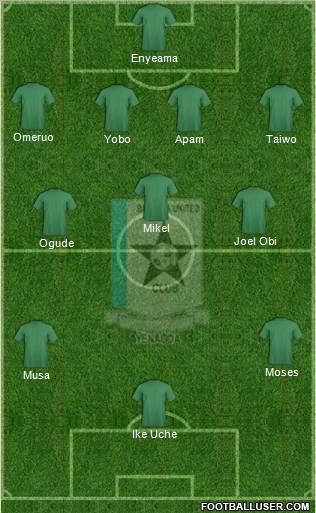
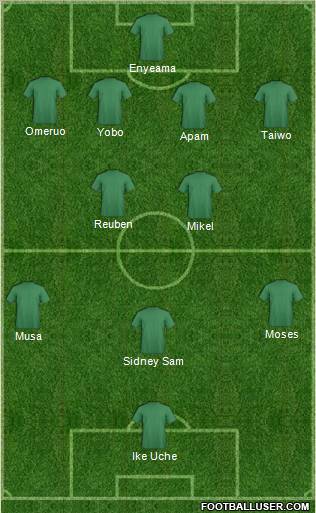
    Two formations are proposed to address the two broad needs for  balance and an attacking game; the 4-3-2-1 and the 4-2-3-1 respectively.

    The 4-3-2-1 is proposed as the primary formation to address the need for balance in the Super Eagles, a weakness that crippled the team under Siasia and remains today under Keshi.

    The main distinguishing factor here is the use of three central midfielders- a trivote to control the center of the field and shephard the opponent's attack out wide.


    John Mikel Obi retains his Chelsea role in front of the central defence to maximize his positional awareness and tactical discipline, as well as enable the team controlled possession. In addition, he has the role of also influencing attacking play from his deep position, using his long range passing skills.

    In this role, Izunna Uzochukwu will compete directly with him, being familiar with a similar role at Midjtylland FC's 4-1-4-1 or 4-3-3.

    On either side of Mikel are two box-to-box midfielders, who are expected to contribute to both attacking play as well as defence. Joel Obi, Fengor Ogude, Gabriel Reuben, and Onazi Ogenyi will compete for the two spots.

    In attack, primary creative play will come from the wide midfielders, which means that an important objective of the build up phase is to isolate the opposing fullbacks for the wide players to run at them. Overall, creative play from central midfield is primarly a function of movement and passing, and not the dribble. The central midfielders are expected to take turns in breaking into the box as 'arrivals'.

    It also means that beyond the three central midfielders, free roles are assigned to the three attacking players, who also form the first two lines in the pressing system in the non-possession phase. However behind them the game is structured and based on positional discipline.

    The wide midfielders will also take turns to switch to the center (central winger) to recieve the ball and unbalance the opponent, with the corresponding fullback pushing up to create an outlet on the flanks, and the central midfielder on that side moving laterally to provide cover.

    In central attack, the key quality required is multi-functionality, speed, and the movement to find space between the lines. The role requires constant switching with the wide midfielders, which means the central striker must have the versatility to play out wide on both the left and right, as well as in a supporting role. The central striker is thus required to have very good technical skills, speed, close control and the ability to play with back to goal, as well as on the shoulder of the last defender. In otherwords, movement and technical skills is the main denominator rather than just sheer power.

    Based on this, Victor Anichebe is not considered a priority. However, both Oba Martins and Anthony Ujah will remain in the frame as they seek to revive their careers.

    In a 4-2-3-1, a double pivot is created in central midfield with Mikel Obi and a defensive midfielder, like Reuben.


    Between the two wide midfielders is a central attacking midfielder, with Igiebor, Chibuike and Sidney Sam competing for the one spot. Nosa Igiebor will need to improve his intensity to make an impact at Betis and thus the Super Eagles. As a result of this, he tends to drift out of games,

    John Chibuike (Rosenberg) has a good left foot, a good eye for a pass and ability to get in the box as an arrival. However his lack of pace will be a constraint.

    Sidney Sam at Leverkusen plays at a higher level than the others. While he may not have expressed interest to play for Nigeria, the reality is that he is available and his window for joining the German national team is closing fast with so many options emerging for Jorgi Loew. I believe that a determined effort to recruit him for the Nigeria project has a good chance of success, especially if handled professionally.

    Defence:
    By far the most number of goals conceded by Nigeria in open play has come from structural weaknesses in midfield, especially in defending the diagonal run or pass from an opponent attacking the inside of the fullback, or the zone between the fullback and the central defence. At the same time, inability to track runners behind the central midfielders, or press the ball high upfield, has on several occassions gifted the opponent time and space to pick a pass through the defence. Addressing these weaknesses is the rationale behinde the use of a trivote in midfield.

    At the same time the quality of defenders available remains a huge problem, and Onyekachi Apam's return should be a major plus.

    Celtic's Efe Ambrose is listed in central defence where his ball skills are best utilized in playing out of defence, rather than as a makeshift right back.

    Michael Odibe is listed on account of his continued progress in rebuilding his career at Ukraine where he seems to have found some semblance of stability on loan to Dnpro. In my opinion this is a talented player, who is strong aerially as well as on the ground in terms of positioning.

    Of the two central defenders from the NPL, Egwuekwe has the greater prospect in my opinion; strong in the air and especially fast for such a big man. The problem is his positioning and ability to read movements of opposing players, which so far is not improving. I am yet to be convinced that based on his talent and the experience of the NPL, Egwuekwe is in a position to be a starter in the Super Eagles.

    Long term, I would keep a keen eye out for the young Tiago Ilori at the famed Sporting Lisbon youth academy, who is starting to break into the first team and is managed by super agent Pini Zahavi.

    But by far the biggest problem in defence remains in the fullback positions, especially at left back. While he has his weaknesses, Taiye Taiwo remains in my opinion the best of the options available, and has the advantage of playing at a higher level than any of his competitors.

    At right back, Kenneth Omeruo has shown enough consistency at ADO Den Haag to merit an invitation to compete with Daniel Adejo who has consistently done well at Reggiana and Obinna Nwachukwu, a right winger with Heartland, whom I believe will be a good prospect for the position, in the same tradition as convereted fullbacks like Sylvanus Okpalla, Ikechukwu Ofoge and Abdul Sule before him.

    Why Obinna? He has all the physical tools to be a top right back- tall and rangy, speed going forward or in recovery, is strong on the tackle as well as aerially, and has good crossing ability. The rest is to school him on the art of defending...

    The defensive system involves three lines of pressing (within zones), begining with the central striker who shows pressure, but retreats, allowing the wide players to press high behind him. The key to this is choosing the time and place to press the ball and not merely running at the opponent hahazardly. This has the additional quality of suprise.

    Of the three central midfielders, the player in the middle (Mikel) should 'hold', relying on his reading of the game more than on high pressing. He has the additional responsibility of playing as the third central defender as the need arises.

    Goalkeeping:
    The lack of first team football by Vincent Enyeama (until recently) and his continued use throughout this period has combined to make the goalkeeping position the least competitive in the Super Eagles since Berti Vogts made the decision to start Austin Ejide in 2008.

    In the absence of any real competitor from the domestic game, Carl Ikeme is listed in expectation that his experience from the English Nationwide will help generate a stiff three way competition.

    At the same time, the CHAN can be used to focus on developing young goalkeepers with prospects for the future.

    Role of the Domestic League:
    The domestic league will be used to scout for players, but only in areas of weakness of the Super Eagles, as opposed to the current approach which is more broad based. The main difference is that the CHAN competition will be the key starting point in the process of getting an invitation to the Super Eagles. In effect, players from the NPL will be assessed on the basis of performance in the CHAN, with greater focus on areas of weaknesses in the Super Eagles such as the fullback positions, except of course if any exceptional players were to suddenly emerge.

    This approach is a recognition of the fact that while players from the NPL may be as naturally talented as the Euro-based players, they play at a level and under a training curriculum that makes them uncompetitive for international football without considerable additional help.

    The reality is that the NPL, especially in terms of quality of players, is not at the level it was when Clemence Westerhof took a predominantly homebased team to the Nations Cup final in 1990.

    Wednesday, September 26, 2012

    Nigeria vs Liberia Preview

    1. Stephen Keshi's squad list of thirty eight (38) players underlines much of the status of his attempt at rebuilding the Super Eagles, with an initially clear and valid strategy of building from the domestic league instead materializing as a convoluted project with no clear sense of direction, increasingly compromised by considerations outside of the technical realm of football.
    2. In goal Enyeama's struggles have drawn attention to the need for competition, but then the invitees are, to a man, all from the same stale pool of shot stoppers, and perhaps apart from Ejide, none of the others has shown himself capable of mounting anything close to a serious challenge for the position...
    3. In defence the critical full back positions continue to be unaddressed seriously. Ambrose looks set to continue as a makeshift right back plodding along. Yet an impressive debut at Celtic is evidence the player can do a lot better, with proper organization of the team. The piss-poor Oshaniwa having transfered to Isreal, is thankfully dropped with Ezekiel invited.
    4. The key issue for me is the seeming absence of progression in the invitation, trial, elimination or subsequent retention and use of players who substantively make the grade in the team.
    5. For all clear intent, only Egwuekwe, Oboabona and Oshaniwa can be said with any certainty to have met this performance standard in defence. Yet the cycle of invitation of the same players continues, with Kingsley Udoh and Ezekiel as the new entrants.
    6. Simultaneously, players who are actually showing signs of progress remain sidelined, like Omeruo, Ogungbe and Taiye Taiwo, as well as Apam who has returned to fitness.
    7. In midfield only Gabriel Reuben meets this performance standard, yet the same cast of homebased players continue to be invited, in spite of lacking the quality to make a difference in the team. Hopefully the CHAN qualifying series will help raise the standards of some of these players and their competitiveness.
    8. At the same time you have young central midfielders like Izunna Uzochukwu at FC Midtjylland consistently overlooked for players of vastly inferior quality, like Raheem Lawal or Obiora Nwankwo whose career has consistently gone south!
    9. Mikel Obi finally returns to the national team, his first time under Keshi's tenure, after repeated lack of commitment to the national cause, and for which Keshi rightly held him accountable. In my opinion we should neither pressure nor force Keshi to invite any player to the Super Eagles. If Mikel's professional ambition in football ends at Stamford Bridge, Fulham Road, London, SW6 1HS, we should oblidge him!
    10. While recognizing his progress at Lazio, the invitation of Ogenyi Onazi appears a little premature, and the young player might have been better served by allowing him room to establish his place in the Serie A team. Nonetheless this is a good chance to get him in the frame of the national team with as little pressure as possible, evangelical interests notwithstanding.
    11. Fourteen forwards are invited, with many of the locally based players expected to be culled before the full camping begins. Of this number there are seven wide forwards, excluding John Utaka from French champions Montpellier who is dropped as unceremoniously as he was invited, even with his continued good form at club level!
    12. Heartland's Obinna Nwachukwu is also dropped from the squad while Gomo Onduku of Sharks returns, nearly two years removed from his better NPL performances.
    13. Seven central strikers are invited, one of them, Fidelis Saviour of FC Taraba in the lower division of the Nigerian league. It is unclear if Kalu Uche is dropped since moving to Turkey. Brendan Ogbu, Tony Okpotu, and Manir Ubale are invited for the first time. And the discordant beat goes on...
    14. A valid strategy for rebuilding the national team is being subverted. It appears that national team invitation is simply burnishing the CVs of players who subsequently parley this for possible transfer abroad.
    15. Let us hope that somehow the Super Eagles is able to benefit from this. See you in South Africa...


    The Eagles squad:

    Goalkeepers:
    Austin Ejide, Vincent Enyeama, Chigozie Agbim (Warri Wolves), Daniel Akpeyi (Heartland)

    Defenders: Azubuike Egwuekwe (Warri Wolves), Papa Idris, Umar Zango (Kano Pillars), Solomon Kwambe, Godfrey Oboabona, (Sunshine Stars), Ezekiel Bassey (Lobi Stars), Kingsley Udoh (Heartland), Joseph Yobo, Elderson Echiejile, Efe Ambrose.

    Midfielders: Gabriel Reuben (Kano Pillars), Henry Uche (Enyimba), Christian Ofili (ABS), Solomon Jabason (Akwa United), Philip Asuquo (3SC), Joel Obi, Nosa Igiebor, Obiora Nwankwo, Mikel Obi, Ogenyi Onazi.


    Forwards:
    Wide Forwards: Ejike Uzoenyi (Enugu Rangers), Victor Moses, Ahmed Musa, Sunday Mba (Warri Wolves), Gomo Ondoku (Sharks), Sanusi Sani (Gombe United), Izu Azuka (Sunshine Stars),
     
    Strikers: Brendan Ogbu (Heartland), Tony Okpotu (Lobi Stars), Manir Ubale (Kano Pillars), Fidelis Saviour (FC Taraba),  Ike Uche, Emmanuel Emenike, Brown Ideye.

    Thursday, August 9, 2012

    Nigeria Can Win the World Cup in 8 Years...

    ....in women football!

    Yes, Nigeria can indeed win the world cup in 2019 and be in the medal rounds in the next olympic games.

    Why do I say this?

    To understand this, let us begin by looking briefly at the state of women football.

    State of Women Football:
    Until recently, the major defining elements of women football have not changed significantly since 1999.

    On the whole, the US still remains the leading nation in the sport, in spite of successful challenges from the likes of Sweden, Norway, China, Germany, Brazil and more recently Japan.

    In turn, US success has been anchored firmly on physical dominance, typically with the big, burly central striker, like Abby Wambach and a mix of a few technical players, like Mia Hamm in the past, and currently Megan Rapinoe.

    Tactically, the game has been based on quite simple formulations, fitness and high work rate, speed and dominance in wide areas, and especially the delivery of crosses or the set-piece into the penalty area.

    Until recently, teams that have overcome the US have had to match their physical advantage, like Germany did in getting to the summit of the women game.

    However this dynamic started to change with the emergence of Brazil and the influence of such technical players like Martha in the ability of the team to control the game with ball possession skills, passing, close control and movement. But the ability of Brazil to dominate has been hampered by poor support from the Brazillian Federation, and poor attention to physical fitness.

    In winning the world cup however, the Japanese have built a program anchors possession and the team game on very high fitness levels and work rate.

    So How Can Nigeria Win the World Cup or Olympic Gold?
    Women football in Nigeria is virtually non-existent as a formal program. But interest in the sport amongst young girls remains and new talent continues to emerge.

    In terms of physical strength, Nigerian women can match anyone in the sport, but their ability to use their physical advantage to be aggressive without fouling have been the major weaknesses.

    Generally speaking the biggest physical constraints Nigerian women teams have in football lies in poor football specific fitness and nutrition, as well as balance and manouverability, which often impacts ball control and speed with the ball.

    In my considered opinion, there needs to be a serious rethink on the focus and choice of players for the national team.

    The Players:
    It is my view that to win the world cup, Nigeria would need to look at a new generation of women footballers, with the following physical characteristics:

    a) Lithe
    b) Wiry
    c) Resilient (physically and mentally)
    d) Pacy (especially with the ball)
    e) Great balance and low center of gravity

    In addition to these physical qualities, they should have good technique, with great emphasis placed on technical training, ball skills, close control, etc.

    Physical conditioning should focus on strength conditioning, enhancing energy levels, stamina and endurance, without build up of unnecessary muscles. Physical conditioning should as much as possible be carried out with the ball.

    Formation:
    The team structure should be based on a 4-3-3 formation, with a game based on controlled aggression, high fitness levels and pressing tactics.

    The primary goal in the non-possession phase should be to physically wear down the opponent with high pressing tactics, but applied cleverly, with emphasis of training placed on giving players the know-how to identify and choose the right moments.

    Because women footballers are on average smaller than men, their is more space on the field in the women game and more room for attacking, with female defenders often struggling to defend the whole  penalty area.

    Consequently the attacking game should be based on two wide forwards/midfielders with pace and the ability to run at a defence from open play.

    Unlike the Japanese model, the goal should not be to use possession as a defensive tactic, but to develop the game in central midfield, control the match, and as a strategic pause to conserve energy levels.

    In the attacking phase, controlled possession in central midfield should be used in a manner to isolate the wide players to run at the defence from the third zone in open play, or create 1v1 situations with the opposing fullbacks in wide areas.


    Coaching:
    All due respects, but in my opinion Khadiri Ikhana is not equipped to coach in women football, both in temperament and overall approach and is better suited remaining in the men's game which he is much more familiar with, and where he has made his greatest impact.

    What is required is to improve on the last coaching structures. In my opinion we should re-hire a technical assistant from the German Football Federation, but one with greater experience than the last one, and on a full time basis.

    We should then hire Mercy Akide-Udoh as Manager to provide overall leadership of the team, as well as serve as a link between the assistant and the players, as well as the playing culture in the Falcons.

    In addition to their primary jobs, they should then be given additional responsibility of establishing periodic coaching programs/clinics in 5-10 strategic locations where women football thrive in the country, both as a scouting mechnism and a strategy for grassroots development of players.

    Women football as yet does not have the competitive level of the men's game. Thus the entry level is lower, which is why in a few years of launching its program, the French for instance have become contenders.

    So yes, if done right, Nigeria can reach the medal rounds in the next Olympics Games in 2016, and challenge for the world cup subsequently in 2019...


    Thursday, August 2, 2012

    The Return of the Locusts: Keshi and the Super Eagles

    Failing to qualify for the 2012 Africa Nations Cup was a significant setback for Nigerian football. That ignominy hangs on the neck of Samson Siasia as the team's coach. But far more importantly, it had the unfortunate effect of erasing much of the good work that he and his crew had done in rebuilding the national team.
    But if his failures erased the positives from his brief tenure, Stephen Keshi's strategy so far could to bury the Super Eagles!
    Aided by a group of chorus singers, from the NFF to politicians, the sports journalists, and a conspiracy of silence by the 'SuperSports punditry brigade', an epic swindle is being undertaken under the guise of rebuilding the Super Eagles.

    At the time Keshi was appointed, I had stated that he inherited:


    "a team which, although it failed to qualify for the ANC, was in much better stage of development than his predecessor was bequeathed; ......a younger team, a more mobile and faster team, and which created more chances per game than previously".

    "In midfield, several key young players had been integrated into what was a staid and stale midfield, such as Joel Obi and Fengor Ogude and Ahmed Musa; while in attack, both Ideye Brown and Emenike were fast settling into the team".

    "But the team struggled in defence, with Efe Ambrose inconsistent in central defence, the right back position still lacking in quality players, while in goal, there is little competition for places. With FIFA's approval of change in nationality petition, both Victor Moses and Shola Ameobi are now available to the Super Eagles, while the Arsenal protege Chuks Aneke has signified interest".  http://nigerianfutbol.blogspot.com/2011/11/from-siasia-to-keshi-past-present-and.html.

    Rather than build on these positives what has happened in the last seven months defies logic and any known precedence in world football. With the exception of Enyeama, Yobo and Ike Uche, an entire new team is being cobbled together from the domestic league with no empirical evidence that the new players are either superior to the players they are replacing, or bring added value to the team..


    It is akin to England, after years of underachievement deciding to retain only Joe Hart, John Terry, Gerard and Rooney, and replacing the rest of the team with players from the English championship!


    In the absence of such empirical evidence, we are being bombarded with tales of how these players are part of a long term 'project' or 'vision' which in time will dominate Africa. And to make the 'tales by moonlight' more believable, it becomes necessary to simultaneously undermine the established players in the eyes of the fans.


    It would be perfectly understandable if these replacement players were fresh, young, talented players with great prospects for the future. Instead they are largely neither fresh, young nor particularly talented. What is worse, they are not improving, in spite of having been in camp for nearly two months, each with the same poor technique, each lacking football intelligence, and an even poorer understanding of team play in the modern game. You do not have to have the extraterrestial eye for talent of an Arsene Wenger to tell that Efe Ambrose is not a right back, and certainly not an international right back. But apparently not in the view of Keshi, who continues to indulge the tedious Ambrose, as he plods along, game after game...

    In 2005 Ejike Uzoenyi was teammates with the late Rashidi Yekini (RIP), and featured in the controversial league match between 3SC and Gateway FC Abeokuta, then managed by Segun Odegbanmi. In the same year, he played for the homebased Eagles against a select Benin Republic side. Seven years later, with the same poor technique and awareness of the team game,  he is being heralded as the emerging star on the left wing who will help the Super Eagles dominate Africa!

    Godfrey Oboabona who is being hailed as a new discovery in defence, joined Sunshine Stars from OSFODEC Academy in 2006!


    New invitee, Sibi Gwar (and Akombo Ukeyima) were the nucleus of the Kwara United attack and led the team in the CAF Confederation Cup tournament in 2007.

    In 2008, Juwon Oshaniwa was called up as Juwon Ayo, from Kwara United to the Flying Eagles team then coached by Ladan Bosso. He failed to make the cut. His full is Oshaniwa Juwon Ayo….
    In the same 2008, and the same Flying Eagles, Reuben Gabriel, hailed as the emerging star of this new homebased 'project' had also failed to make the team after being the established central defender at Kaduna United

    Reuben Gabriel and Phillip Asuquo tangle in the league

    In December 2010, Philip Asuquo, then of Crown FC Ogbomosho, was being profiled by MTN.com. He had been previously with Plateau United.

    In 2004, Benjamin Francis was playing as a right back in a league game for Plateau United against Nationale. Today he is invited to mount a challenge for the right back position.

    New invitee, and fresh faced Umar Zango, was playing in defence for Lobi Stars against Sharks, in the 2003 FA Cup final!

    Let there be no misunderstanding! Players emerge at their own pace. Some are fast, some are late bloomers. As they say in Liverpool, form is temporary, and class permanent.
    But presenting these players and the Keshi homebased experiment as the breath of fresh air to cleanse the stale Super Eagles, is nothing short of false advertising, and the protagonists of this falsehood know it! Clearly the era of the locusts is back again amongst us!
    Rather than the bold new approach being advertised, the reality is that what hapless Nigerian football fans are being offered is largely a group of players recycled several times over, and who have shown negligible progress in their careers to merit the faith being placed in them.

    In seven months and after about ten matches, including four competitive games, what is emerging under Keshi is a team that is prosecuting games outside of a proper tactical organization, with little attention to details, even against piss poor opposition. Within this framework, the homebased players are repeating the same mistakes and the more experienced foriegn based players have all but abandoned all pretences of team play! Not suprisingly, players like Moses and Aluko who learnt the game structurally, are increasingly struggling. Even John Utaka who played with such dash and fizz at Montpellier looked ponderous. He has since returned to the status quo at the French champions. This is a dangerous sign, for football always tells you the truth.


    After seven months and about ten games, what is increasingly evident is a coach with strong leadership and motivational skills, but severely lacking the ability to develop a strong tactical framework within which to play the game.

    In the modern game there are typically coaches (like Jose Mourinho, Brendan Rogers or Tito Villanova) and managers (like Alex Ferguson or Kenny Dalglish); the difference being that one is hands on, while the other sets the general direction, with an assistant as the trainer who does the actual tactical work on the ground, like Steve Clarke (for Dalglish) and Carlos Quieroz (for Ferguson). Some coaches bestride this divide, like Mourinho.

    Unfortunately, many in the NFF Technical Committee do not know the difference. More importantly, it appears increasingly that even Stephen Keshi does not know on which side of the divide he belongs! Rather than hire a proper assistant, he has saddled himself (or allowed) with Daniel Amokachi. The result is a Super Eagles with a mediocre bench and a preponderance of raw talents.

    This is the team around which a huge public relations exercise is being undertaken.

    Nigeria will beat Liberia and qualify for the Nations Cup. On the face of it, and to simplistic followers, we will be deemed to be making progress as Keshi would've already surpassed Samson Siasia's performance in the Super Eagles. But football always tells you the truth. How you choose to interprete it is your own selenge...